
Endodontics • Bioceramic sealers • Root canal obturation
Best Endo Sealer UK: Bioceramic Sealers vs Epoxy Resin Sealers
Choosing the best endodontic sealer is no longer just about tradition. Modern dentists increasingly want a root canal sealer that combines excellent flow, biocompatibility, dimensional stability, radiopacity, moisture tolerance and predictable clinical handling.
This guide compares traditional epoxy resin sealers with modern calcium silicate-based bioceramic sealers and explains why many UK dentists are moving towards bioceramic obturation systems such as One-Fil.
Bioceramic Sealers
Calcium silicate-based, moisture-activated sealers designed for modern obturation workflows.
Epoxy Resin Sealers
Long-established sealers with a history of use, but with limitations around cytotoxicity and shrinkage.
Single Cone Obturation
A simplified hydraulic obturation technique commonly used with bioceramic root canal sealers.
One-Fil Sealer
Toothsaver’s clinician-selected calcium silicate-based bioceramic sealer.
What is the best endo sealer?
The best endo sealer depends on the clinician’s obturation technique, canal anatomy, moisture control, restorative plan and preference for handling. However, for many modern endodontic workflows, the ideal sealer should offer:
- Excellent flow into the root canal system
- Strong adaptation to dentinal walls
- High radiopacity for post-operative assessment
- Dimensional stability after setting
- Low solubility
- Excellent biocompatibility
- Moisture tolerance within the root canal environment
- Predictable handling and easy placement
Historically, epoxy resin sealers have been widely used in endodontics. Today, calcium silicate-based bioceramic sealers are increasingly chosen because they are designed to work with the humid environment of the root canal system and offer favourable biological properties.
Toothsaver clinician view
For clinicians searching for the best endo sealer in the UK, the key question is not simply “which sealer is most famous?” It is: which sealer gives reliable flow, radiographic visibility, biocompatibility, efficient placement and strong value in real clinical use?
Why bioceramic sealers have changed endodontic obturation
Bioceramic sealers are typically calcium silicate-based materials. They are hydrophilic, meaning they are designed to function in the presence of moisture. This is important because the root canal system is not a completely dry environment.
Calcium silicate-based sealers use moisture to support the setting reaction. They can also interact with dentine and may form hydroxyapatite at the sealer-dentine interface, helping create a biocompatible seal within the canal system.
This is why bioceramic sealers are commonly associated with modern single cone hydraulic condensation techniques. A well-fitted gutta percha cone is combined with a flowing bioceramic sealer to create a seal inside the canal system.
Best suited to modern hydraulic obturation
Bioceramic sealers are often chosen for single cone hydraulic condensation because they flow well, are moisture-activated and are designed to adapt within the root canal system.
Bioceramic sealer vs epoxy resin sealer: key differences
| Feature | Bioceramic / calcium silicate sealer | Epoxy resin sealer |
|---|---|---|
| Setting environment | Hydrophilic and designed to set in the presence of dentinal moisture | More dependent on controlled conditions and resin polymerisation |
| Biocompatibility | Excellent biocompatibility is a key reason clinicians use calcium silicate-based materials | Can show biological limitations, particularly before complete setting |
| Moisture tolerance | Designed to work with moisture present in dentine and the canal system | More technique-sensitive where moisture control is difficult |
| Dimensional stability | Modern bioceramic sealers are selected for dimensional stability and low solubility | Resin chemistry may involve polymerisation-related dimensional change |
| Obturation technique | Well suited to single cone hydraulic condensation and bioceramic obturation | Often associated with more traditional obturation workflows |
| Clinical appeal | Simple placement, biological advantages and efficient modern workflow | Long history of use and familiarity for many clinicians |
Advantages of bioceramic sealers in endodontics
Calcium silicate-based sealers are used because they are well suited to the biological environment of the root canal system.
Bioceramic sealers are hydrophilic and use moisture to support the setting reaction.
Their flow and dentine interaction make them useful for sealing complex canal anatomy.
Low solubility and dimensional stability help maintain a stable root canal seal.
Ideal for clinicians using single cone hydraulic condensation with matched gutta percha cones.
Premixed syringe systems reduce chairside mixing and make placement more predictable.
Are epoxy resin sealers still useful?
Yes. Epoxy resin sealers have a long history in endodontics and remain widely used. Many clinicians are familiar with them, and products such as AH Plus have been part of traditional obturation workflows for many years.
However, the growth of bioceramic obturation has changed how many dentists think about sealers. Instead of selecting a sealer only because it has a long clinical history, clinicians are increasingly considering moisture tolerance, biological response, handling, flow and suitability for simplified obturation techniques.
This is why the conversation around the best endo sealer has moved beyond epoxy resin sealers alone.
Toothsaver clinician choice
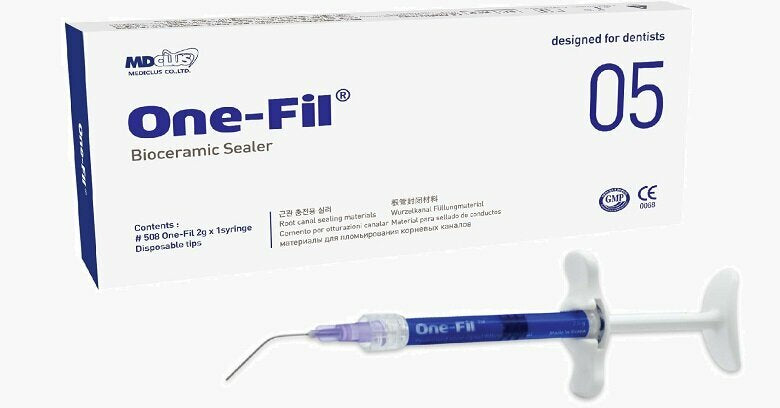
One-Fil Bioceramic Root Canal Sealer
At Toothsaver, One-Fil Bioceramic Root Canal Sealer is our clinician-selected calcium silicate-based sealer for dentists looking for a practical, resin-free, premixed bioceramic sealer with excellent flow, high radiopacity and strong value.
One-Fil is suitable for single cone hydraulic condensation, lateral condensation and warm vertical condensation techniques.
View One-Fil Bioceramic SealerWhy One-Fil is a strong choice for dentists looking for the best endo sealer
One-Fil is a premixed, calcium silicate-based bioceramic root canal sealer designed for modern obturation. It is especially useful for clinicians who want a syringe-ready sealer that is easy to place and suitable for hydraulic obturation workflows.
For dentists searching for the best endo sealer in the UK, One-Fil is a strong option because it combines several features that matter clinically:
- Premixed syringe formulation
- Calcium silicate-based chemistry
- Resin-free formulation
- Excellent flow
- Strong adhesion to dentinal walls
- High radiopacity
- High pH during setting
- Compatibility with single cone hydraulic condensation
- Compatibility with lateral condensation and warm vertical condensation
- Strong value for UK dental practices
Best endo sealer for single cone obturation
Single cone hydraulic condensation has become popular because it can simplify obturation while making use of the properties of modern bioceramic sealers.
In this technique, the clinician prepares the canal, fits a gutta percha cone accurately, places the bioceramic sealer and uses the hydraulic movement of the cone to distribute the sealer through the canal system.
For this technique, the sealer matters. It needs to flow well, adapt to dentine, work in a moist environment and remain dimensionally stable after setting. This is one of the reasons calcium silicate-based bioceramic sealers such as One-Fil are increasingly selected.
Looking for a best-value bioceramic sealer?
One-Fil is a premixed calcium silicate-based root canal sealer designed for excellent flow, high radiopacity, easy placement and predictable bioceramic obturation.
Shop One-Fil Bioceramic SealerScientific references
Published research has examined the physicochemical properties, cytocompatibility and setting behaviour of contemporary calcium silicate-based endodontic sealers. These areas are clinically important because an endodontic sealer must perform inside a humid canal system while maintaining sealing ability, biocompatibility and dimensional stability.
Scientific reference
Physicochemical properties and cytocompatibility
Research comparing contemporary calcium silicate-based sealers, including One-Fil, with assessment of physical properties and cytocompatibility.
View referenceScientific reference
Moisture and setting behaviour
Research discussing calcium silicate-based sealers and the importance of moisture availability for setting behaviour.
View referenceClinical cases and university-associated data
Please contact Toothsaver to access hundreds of clinical reviews and clinical follow-up examples for One-Fil.
Data has also been collected in association with the University of Central Lancashire for One-Fil sealer and the University of Newcastle for One-Fil PT.
Clinical applications and placement tips
One-Fil can be used in a range of obturation workflows. Clinical videos are available to show how to place the sealer and how to integrate it into everyday endodontic treatment.
Clinicians may also wish to consider visco tips, also known as material-saving tips, to support more accurate placement of sealer and reduce material waste.
See clinical videos for guidance on how to use One-Fil Bioceramic Sealer in everyday endodontic obturation workflows.
Consider visco tips to allow more accurate placement of sealer and reduce waste.
Contact Toothsaver for access to clinical reviews, follow-ups, case examples and practical product guidance.
So, what is the best endo sealer for UK dentists?
There is no single sealer that is automatically best for every clinician, every technique and every case. The best endodontic sealer depends on the clinical situation, the canal anatomy, the obturation method and the dentist’s preferred handling.
However, for UK dentists looking for a modern sealer with excellent biocompatibility, moisture tolerance, dimensional stability, flow and reduced technique sensitivity, a calcium silicate-based bioceramic sealer is a strong choice.
One-Fil Bioceramic Sealer is Toothsaver’s clinician-selected option for dentists who want a practical, premixed, resin-free bioceramic sealer for modern root canal obturation.
Shop One-Fil Bioceramic Sealer
One-Fil is a premixed calcium silicate-based root canal sealer designed for excellent flow, high radiopacity, easy placement and predictable bioceramic obturation.
It is suitable for single cone hydraulic condensation, lateral condensation and warm vertical condensation techniques.
View One-Fil Bioceramic SealerFrequently asked questions
What is the best endo sealer in the UK?
The best endo sealer depends on the clinician’s technique and case selection. Many UK dentists now choose calcium silicate-based bioceramic sealers because they offer excellent biocompatibility, moisture tolerance, flow and suitability for single cone hydraulic condensation.
Are bioceramic sealers better than epoxy resin sealers?
Bioceramic sealers offer advantages in moisture tolerance, biocompatibility and modern hydraulic obturation workflows. Epoxy resin sealers still have a long history of use, but many clinicians prefer bioceramic sealers for contemporary endodontic techniques.
What is a bioceramic root canal sealer?
A bioceramic root canal sealer is usually a calcium silicate-based endodontic sealer designed to seal the canal system after cleaning and shaping. These sealers are commonly used with gutta percha during obturation.
What is single cone hydraulic condensation?
Single cone hydraulic condensation is an obturation technique where a fitted gutta percha cone is used with a flowing bioceramic sealer to create a seal within the root canal system.
Is One-Fil a bioceramic sealer?
Yes. One-Fil is a premixed calcium silicate-based bioceramic root canal sealer.
Is One-Fil resin free?
Yes. One-Fil is a resin-free endodontic sealer.
Can One-Fil be used with warm vertical condensation?
Yes. One-Fil can be used with warm vertical condensation, as well as single cone hydraulic condensation and lateral condensation. As with all sealers, clinicians should avoid excessive heat deep inside the canal.
Where can UK dentists buy One-Fil?
UK dentists can buy One-Fil Bioceramic Root Canal Sealer directly from Toothsaver.